June 27, 2018

June Gaming Activities

Maurice


Well, here it is, nearly the end of June, and I almost  missed writing a post. I don't want to let down my dear readers, so I wanted to share what's been going on in my gaming life. Most of my hobby activity this month has been painting (more about that later), but just this past week, my good friend Charles came over to my home to play Maurice, by Sam Mustafa. We played about 3 hours on  Tuesday night, but hadn't played all the way through the second deck. So we agreed to resume the game on Thursday night. How it took us six hours to play a game rated to take only 2-3 hours I don't know, but it was the most fun I have had playing a wargame in ages, and confirms my feeling that Maurice belongs firmly in my top 3 favorite wargames of all time.

We made a lot of errors while playing, most notably my charges on his cavalry at the end of the game. I took away his last morale point on the last turn I could play, as we had no more cards left after that. It was an epic victory for me, achieved by forgetting the rule that infantry cannot charge cavalry, unless the target unit is in a town. But it was still great fun, for my opponent as well me! I didn't get any pictures of the game in progress, but my recorded the second session, which I will link to as soon as it is posted.


American Civil War, home brew rules


On Sunday afternoon, I was graciously invited to join another friend, Glenn, at his man-cave gaming shed, to play  Glenn's home brew version of Battle Cry along with Charles and Nick. 

Glenn has been working on this game for awhile now, and was testing the rules with a historical scenario, Gaines' Mill. This was one of the Seven Days' battles that concluded George McClellan's peninsular campaign in 1862.
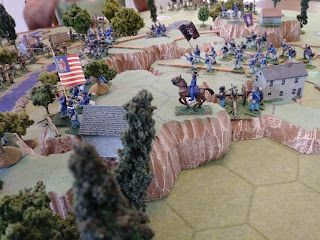


If the dice in the second picture look familiar, they are straight from Battle Cry/Command and Colors series of games. What was different about this variant were the cards used to activate units in the game. 

Before the game, I was concerned that in a multiplayer game, I would spend a lot of time waiting for my turn. Indeed, that is exactly what happened the one time I played in a 6 player epic scale C&C Ancients game. Instead, this version had each player on a side draw 5 cards, and each round, each player would secretly select one card from his hand. 


The order of activation is determined by the number next to the clock symbol at the bottom center of each card, with more aggressive actions taking place later in the round (higher numbers). The occasions where both sides have the same activation number were resolved by taking turns exchanging the initiative.

At the end of five rounds (when all the players' cards were exhausted), all the players drew five new cards, and a new turn began. This format worked extremely well for a miniatures game with more than one player per side. Indeed, it could easily be scaled up as large as you wished, so long as your table space and miniatures collection permits. 


While the rules worked extremely well, our host determined that the Union army should start with fewer troops on the table at start, to give the Confederate army the opportunity to attack sooner than historically, and make the scenario a closer contest. The number of CSA units destroyed was overwhelmingly higher than the number of Union units lost.

That's all the miniatures gaming I for this month of June. In addition to miniatures, my wife and I have played at least one game of Catan with our next door neighbors on my birthday. But euro games are not the focus of this blog, so I won't dwell on that. 

May 16, 2018

How I accumulated my wargaming library, and how I minimized it

Getting started, with Avalon Hill


When I started wargaming in the late 70’s with Avalon Hill board games, there was absolutely no need for me to have any knowledge of uniform details in order to play Tobruk or War and Peace, or any other board game. The history behind each game was certainly of interest, but for the WW2 games, we had Saturday morning war movies and documentaries, Kelly’s Heroes (cue laughter), and my Dad’s Life picture history of World War II to inspire us. And the model displays at the local hobby shop gave us a clear image of what our cardboard counters represented. 


As for Napoleonic history, the potted historical summaries at the beginning of each scenario in War & Peace (above), or on the back of the box, were all we had. And as I recall, the only game with an ancient theme I played before miniatures was Caesar at Alesia. But I would not have been able to distinguish between an Austrian jaeger and a grenzer, a Hittite and a Babylonian, or a cuirassier and a chasseur.


But in the fall of 1989, I picked up Napoleon’s Battles off the shelf at a game store in Orlando FL, and my fate was sealed. This was my gateway to miniature wargaming! The only color photo on the entire box was a small, maybe 3”x4” scene, depicting Prussian landwehr defending a walled farmhouse against a French assault. Now, I could command an army of life-like soldiers instead of chips of cardboard with a silhouette and a numeral on them.


Collecting my first figures and military history books

So I bought the game, and ordered some figures from Modeler’s Mart in Clearwater FL. Later on, I would drive out there to visit their warehouse to buy even more figures. Alongside my first order, I bought the two volume Funcken guides to Napoleonic uniforms. The guides is are incomplete, and likely inaccurate in places, but I love the illustrations.


Even more books


It wasn’t long however, before I was introduced to the Osprey guides, and began to collect them. And then Napoleonic history volumes. And then ancient history. And Civil War history. My library expanded faster than I could read them all. The uniform guides were necessary, because I wanted my troops to be painted as accurately as possible. How disappointed I was to find that many of the guides I had were incomplete, or even inaccurate.

Purging the library


By the time my wife and I left San Diego for the Carolinas, it had been 24 years since I began Miniatures. In that time, we have seen a wealth of information being made available on the internet for free. So my library of Osprey guides was no longer necessary, and I was able to free up 3’ of shelf space by giving them away. I also let go of many other books before I left, books I had already read, and no longer wanted in my life. I did keep a few references, like the Funcken guides, and the Mollo guide to uniforms of the American Revolution, plus 2-3 more. I also still have my Campaigns of Napoleon, by Chandler. But otherwise, my collection had included far too many redundant volumes.


I still have quite a few books, and may likely let even more go, but I probably gave away a full third of my books before we left. It was a relief to feel a weight taken off my shoulders, and I don’t regret my choice to let go of them.

April 5, 2018

Song of Drums and Shakos AAR

So last weekend, my wife and I decided to break out "Song of Drums and Shakos" from Ganesha Games. She has shown a keen interest in my "little guys", and SDS is an easy game to get into. Since I already have the scenery, especially the farmhouse, for the "Take the farmhouse" scenario in the basic rule book, that is the scenario we chose to play.

Setup

I took the French, at 520 points, and the Mrs. took the British, defending the farmhouse with 400 points. In my merry little band, I had 4 grenadiers, an officer, drummer, eagle-bearer, and a half-dozen line company infantry with an NCO, in case the officer were to be rendered hors d' combat.

For the British, I gave them an officer, NCO (love the halberd!), drummer, 6 grenadier company, and 4 line company soldiers. After playing the scenario, I don't think the drummer is useful for the defenders holed up in the farmhouse; you aren't likely to be making group activations while spread out over defensive positions. Maybe there's a chance for a 'regroup' order, but that's about it.


Le Rosbifs


To battle!

So, coming on from my deployment position, having no voltigeurs or legere, I decided to go straight up the road and ignore the woods. I lead off with a column of line infantry under orders from the officer, with the NCO tagging along for support. The grenadiers were meant to follow immediately, but they would have to wait until the following turn (I failed my next activation).


The British meanwhile, seeing the French heading for the bridge, began pouring out of the farmhouse, leaving only a pair of their mates to man the window closest to the bridge. The French line company troops charged with a great cheer towards the bridge, with the NCO cheering them on. However, the British fire was withering; several of the French soldiers fell instantly, while others tried to return fire, but they were so rattled that their shots missed widely.

This bridge is too steep, as the soldiers kept sliding off and falling over; I need to scratch build a new bridge out of wood.

Two brave men of Gascony charged across the bridge to cross bayonets with le rosbifs, but were set upon by two British soldier's each, and were also quickly put down.

The white pom-poms indicate unloaded muskets; I like them better than cotton balls, because they don't get all over the place.

Finally, lieutenant Deja Vu ordered the grenadiers forward, trying to pour his best men into the fray with a group order. Ponderously (getting only one success out of two rolled), it took at least two turns for them to get within range. The officer followed along behind, to command his best troops to setup a firing line across the creek, but they too were quickly brought down by deadly fire from the British muskets. The drummer and eagle bearer never moved the entire game!

Denoument

Finally, the numbers began to tell, and the French morale broke, with even the standard bearer dropping his precious eagle and running for camp. His sweet Amelie waited there to console him. The British cheered as they saw the backs of Johnny frog (as usual), and the captain ordered a ration of gin all around!

The French NCO runs away into the woods. (Woodland Scenics ready-made trees on wooden discs). The wooden disc bases look awful here, but at the time of this writing, I have rectified that with wood glue, sand, paint, and reindeer moss and Spanish moss.


Comments about the game

 This is not the first time I have played this game, not even the first time I have played this scenario. But this is the first time I have been able to put my thoughts about the game in this blog. It is not likely to appeal to grognards who seek strict realism, as it is not meant as such a game. Rather, it is an adaptation of the popular "Song of Blades and Heroes" to a Napoleonic setting. Furthermore, there is no strict ground scale; everything is measured in the very abstract short/medium/long lengths that were introduced in SoB&H. But if you want a fun and exciting game you can play with your Napoleonic miniatures, this is a game for you.

Some critics like to point out, quite smugly, that there was no such thing as a "squad" in Napoleonic times, and that the rules allow an unrealistic mis-match of troop types in the same force that would never have fought together. For example, you could take a pair of dragoons on horseback with your legere squad and a handful of grenadiers. However, I never expect to use this set to create historically accurate or realistic battles; rather, I expect to have fun with some painted 28mm figures in interesting scenarios.

Some of the special rules are unrealistic though. One of them is the "light" special rule, which allows light infantry like jaegers, grenzers, and legere to move through rough terrain or woods at the normal movement rate. In larger scale games, like Drums and Shakos Large Battles, these faster movement rates make sense; units of light troops do not have to dress lines and maintain cohesion, since they are moving in looser formations. While moving around individual soldiers however, everyone on the table is capable of moving in loose formations. That being said, I accept the rule, as it makes such troops distinctive.

Anyways, that's my take on the game, one of my favorites!


March 14, 2018

Painting Figures

I am getting to work on my next two battalions of 15mm French, 12 figures per battalion. I have in the past painted brigades for Napoleon’s Battles at 24 figures each, and later, 32 figure battalions for Sam Mustafa’s Lasalle. For my new collection, I am painting smaller units for several reasons: they are quicker to paint, which encourages me to keep going; they require fewer figures, which allows me to use the odds and ends I have left over; and finally, they take less table space, which allows more room for maneuver. Large battalions look impressive on the table, but too many of them, and you end up with both armies wall to wall, and the only option is to charge straight ahead.


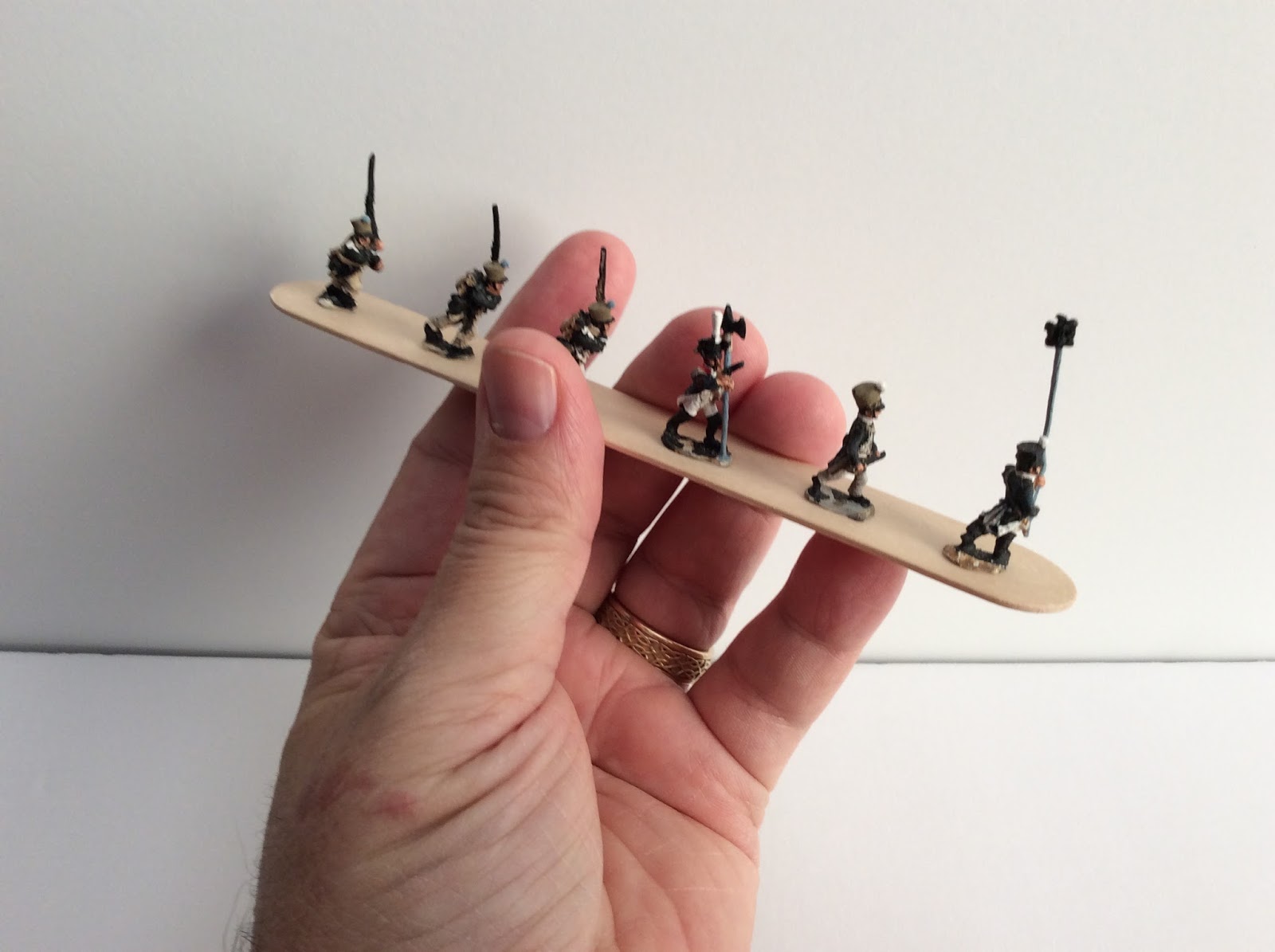
What I wanted to write about today however, is two methods I have used to mount figures for painting. The first method I have used since I began in 1989, which is to mount the figures on popsicle sticks or tongue depressors. The depressors are better than the popsicle sticks I began with, but they can still cause fatigue in the hand that holds the stick.

Some time in the late 1990s I was acquainted with a gentleman in San Diego named James Hansen, who was a beginner painter and avid wargamer. In his case, being a beginner was an asset, because he came up with the brilliant idea of gluing 4 popsicle sticks in a hashtag (#) arrangement. This makes for a comfortable, ergonomic handle for holding the figures for painting. I have used it ever since, at least for my 15mm figures, where mass production is the key.


For 25 mm figures, I fix them to 20mm washers, and I handle them individually. When I return to them, I should look into a form of wooden handle with rare earth magnets, or a medicine bottle with poster putty. I have read about some painters mounting their figures on roofing nails, so that they can rotate the figures to access all sides of each figure, but I am in the business of mass production of my battalions, and am fine with a few highlights and picking out those few details (like Shako cords) that really stand out.

What do you think? Do you have a favorite method of painting that you would like to share?

March 2, 2018

Quick and dirty (aka crappy) paint job + donated figures = mission accomplished

What have I been up to since my last post? A mix of board gaming, some miniatures gaming, a little painting, and wasting more time than I care to admit on The Miniatures Page. I must be more intentional as I consider the use of my time, as much as I consider what things to hold on to, from hobby projects to household goods, clothes, whatever.

Like many wargamers, I do lose enthusiasm for painting from time to time. But I find the best remedy for that is completing something. So I present for your enjoyment some completed WW2 Soviets. These were plastic Warlord figures donated to me by a close friend, apparently from a project he was no longer interested in. 


Rifle squad, including some LMGs and a sniper.

I started with a prime and base coat of camouflage color khaki from Walmart's camouflage spray paint line, followed by a dark wash. The rest of the figure was all about high-lighting, and painting a few details, ignoring others, and finishing off the bases. The faces I painted with a base coat of Ceramcoat Tomato red, followed by straight flesh. Usually I would mix some mid-tone between the two, but I think on these figures, simpler is best. Some details, like the chin straps on the helmets, I left unpainted.

Two of the figures are from the Wargames Factory line, which I believe are no longer available. I know that the Wargames Factory lines were bought out by Warlord Games, and their AWI figures are still available there, the WW2 figures are a superior design. The Wargames Factory would only be available from shops that carry leftover stock, or on eBay, but I would advise not bothering with them.


Assault Squad, armed with the PPSh
What I have learned from assembling these figures is that the best way to match weapons and arms is to dry-fit these pieces. First, place some glue on the right shoulder, and give it about 30 seconds to a minute for the plastic at this location to begin to dissolve; remember that "plastic cement" is a solvent for the model plastic. Then, attach the right arm. Once the right arm is set, then  dry-fit the weapon and the left arm. If the left arm doesn't fit, try a different left arm from the sprue. Glue the weapon into place on the right arm, and when that is set, glue on the left arm. 

I can use these figures in a game of "Flying Lead" or "Chain of Command". That is the beauty of individually-mounted figures. Best of all, since completing this project, I am once again enthused about painting the next thing. This will be more French battalions for DSLB.

Other Projects

Other things I have worked on in the last eight months include: painting some orcs from Reaper miniatures (which I can use for Song of Blades and Heroes), a dismounted Old Glory crusader knight (painted to match my mounted version of him), and two battalions of French for Drums and Shakos Large Battles. My next posting shall have to be why this is my game of choice for Napoleonic wargaming.

He can fight just as well without his horse!

The helmet on this figure is identical to the mounted figure, and so I matched the heraldry as best I could. In a future post, I must show how I paint shield designs and heraldic devices.

On the rear of the figure below, you can see how the mail coat and helmet look so like metal; that's because it is! I began work on the figure by polishing it with steel wool to a shine. Then I gave the figure a black wash, and polished it a second time time with steel wool.

After that, I primed the non-metallic parts of the figure with Liqui-Tex gesso, and painted these parts carefully. I received this tip from George Cavanaugh, a long-time friend of mine from San Diego. Of course, this method does not work with plastic figures!

 Here are the first of my French battalions for DSLB:

Line battalion on the left, Legere on the right. Some 5-7 of these comprise a brigade, and I need two brigades and a small reserve

June 7, 2017

An account of our recent activities; or, why I haven't posted in four months.

Sometimes, as we know, Real Life(tm) can interfere with our little hobbies. And blogging on the wargaming hobby is only another aspect of the hobby alongside painting, making scenery, and playing games. Since my last post in February on the DBA event, I have played a few games, including more DBA, Power Legion, as well as a few board games.

But we have also taken a road trip, and put up a privacy fence, which took us about six weeks to complete, thanks to my work schedule and that of my neighbor. Our garage became the storage facility for all of our building materials, and a lot of my free time was directed toward the fence project, planning the road trip, taking the road trip, and working lots of overtime. So it has been awhile since I've had time to put paint and brush to figures.


So this past week, I broke out some Blue Moon 18mm War of 1812 American infantry. I had already finished two battalions of these figures a few years ago, with the intention of fielding the forces of both sides for Queenston Heights and Chrysler's Farm. I have the Canadian Wargamers guide, "Rocket's Red Glare", and have only played the rules once, for an AWI scenario, Cowpens. I have about three, almost four battalions left to paint, before I can justify buying more. 


The War of 1812 is a small but significant conflict, especially for Canadians, and well within reach of modest figure collections. It also appeals to my American and Canadian heritage. This project also allows me to cannibalize some of the British figures I had collected for Napoleonic wargames back in the 90's, and I will also be able to use a lot of the same worm fences, plowed fields, and log cabin models as I use in my Civil War and AWI games.  I still have some ways to go, as I will need generals, artillery, militia, and a few cavalry and Indians. But I have other figure collections I can work on in until Christmas rolls around on the calendar.

One thing I have found that makes painting more enjoyable is listening to podcasts and YouTube videos. My current favorite is "Tabletop Minions" with "Atom Smasher" Tabletop Minions: "Why don't you just start?"

Indeed, why don't I just start?

February 25, 2017

DBA Day of Battle

Last Saturday, February 18th, some local members of De Bellis Antiquitatis Carolinas, a facebook group, gathered at my home to play DBA 3.0 for a few hours. I will have to write a special post in the near future to extol the many reasons why I love De Bellis Antiquitatis, but suffice to say it is one of my favorite wargames.


Beefier than 2.2, with a higher price tag to match. But worth every penny.


I was concerned after attending Siege of Augusta in January, and Historicon in 2015, that interest in DBA might have waned since the last time I had played in a tournament in Glendale CA; 2006, or 2007. Some of this may have to do with the split in the DBA community over the development of 3.0, but more likely it is that in the age of Flames of War, Saga, Bolt Action, etc., DBA does not have the flashy commercialism and exposure that the newer, more popular games do.

Charles runs my Republican Romans vs Robert with Charles' Carthos. Elephants are one of those special troop types that ancients wargaming offers.
 So I knew that if we were to continue to enjoy this great game, especially as I believe this edition is the best yet produced, we would have to organize our own game event, and invite as many people as we could. We hope to do this at least every 2-3 months, and generate interest in building armies and encouraging others to join in. I believe that DBA is one of those games that requires the players to spread the word and help it succeed.

So I began furiously assembling the materials to host a few games in my garage, in case no one else brought their own gear. Of the six of us who were there, four of us had our own armies, but I had plenty to share. What I did not have was more than one game mat, so I bought some felt, some elastomeric patching compound, and a few cans of spray paint. For the cost of about $25, I had enough to make one 2'x2' standard mat, one 3'x4' mat for a big battle scenario, plus a water way.


We met in agreeable weather in my garage, with six of us in attendance. Jason up from Columbia, SC, while Robert, Nicholas, and Sean came down from Charlotte, NC, and Charles from Fort Mill. We casually determined pairings, then set to with our first games. Sean was the only one who had never played before, so I made sure he was paired with Jason, who is a veteran DBA player. My first game was against Nicholas, as I had promised to pitch my Hittite empire army against his Mycenean Greeks. Charles and Robert faced off with my Polybian Romans vs Charles' newly-painted Carthaginians. Charles had been so jazzed about playing DBA again, that he painted his entire army in about a week!

My Hittites, trying to break out into the open plains to take on the Greeks beyond.

In the second round, I faced off with Robert, pulling out my Shang Chinese and Koryo Dynasty Korean. These are 2.0 list armies, and definitely the most exotic in my collection. For those who complain that 3.0 has made their 2.0 armies obsolete, the figures work just fine with 3.0. We simply used the figures on had, and had a great time.


In the third round, we moved into the high middle ages with Hundred Years War vs Medieval French, me against Sean. By this round, Robert was playing against Jason, using Jason's Arabs and Rajputs. Nicholas and Charles mirrored our game, also with HYW English vs. French.


The wide variety of armies used at the event showcased the different character of each army, and how these differences affect the tactics to use. Next time I will use my Parthians to test the rules for rear support for light horse.
The plan was to finish up the day with a final big battle game, 3 on 3, but we ran out of time, and it was raining and becoming uncomfortably cool. If I was hopeful that our event would generate sufficient interest to play this game on a regular basis, this was confirmed in the next week as facebook postings and messages among the attendees started to share their plans to buy the rule book, collect and paint armies, etc. Since interest seems to be focused on republican Rome and the Macedonian Empire, I may have to look into putting together a campaign map that would allow us to play a simple campaign at one of our future events.